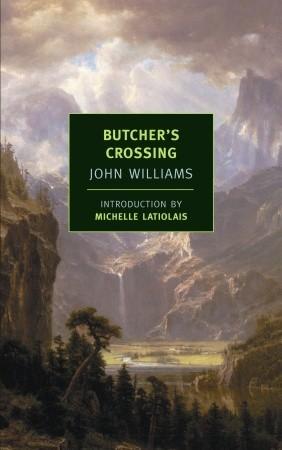
Butcher's Crossing
by John Williams
John Williams' 1956 novel follows Will Andrews, a Harvard dropout who joins a buffalo hunting expedition in the Colorado wilderness. Like Blood Meridian, it presents the frontier as a space of violence and existential reckoning, where civilization proves fragile against raw nature and human brutality. Williams' sparse prose and refusal to sentimentalize either the landscape or his characters create a somber meditation on American expansion that predates and anticipates McCarthy's later interrogation of Western mythology.
In his National Book Award–winning novel Augustus, John Williams uncovered the secrets of ancient Rome. With Butcher’s Crossing, his fiercely intelligent, beautifully written western, Williams dismantles the myths of modern America. It is the 1870s, and Will Andrews, fired up by Emerson to seek “an original relation to nature,” drops out of Harvard and heads west. He washes up in Butcher’s Crossing, a small Kansas town on the outskirts of nowhere. Butcher’s Crossing is full of restless men looking for ways to make money and ways to waste it. Before long Andrews strikes up a friendship with one of them, a man who regales Andrews with tales of immense herds of buffalo, ready for the taking, hidden away in a beautiful valley deep in the Colorado Rockies. He convinces Andrews to join in an expedition to track the animals down. The journey out is grueling, but at the end is a place of paradisal richness. Once there, however, the three men abandon themselves to an orgy of slaughter, so caught up in killing buffalo that they lose all sense of time. Winter soon overtakes them: they are snowed in. Next spring, half-insane with cabin fever, cold, and hunger, they stagger back to Butcher’s Crossing to find a world as irremediably changed as they have been.
View on Amazon